 English
Views: 0 Author: Site Editor Publish Time: 2026-07-15 Origin: Site
TL;DR:
A well-designed swimming pool filter setup combines the right filtration equipment, correct sizing, and reliable components to maintain water clarity and safety. For commercial facilities, selecting a sand filter with sufficient flow capacity is critical. Topguy Pool offers factory-direct filtration solutions built for both residential and commercial applications.
Crystal-clear water doesn't happen by accident. Behind every sparkling pool is a filtration system that runs quietly, consistently, and correctly. Get the setup right, and your pool stays clean with minimal intervention. Get it wrong, and you're dealing with cloudy water, chemical imbalances, and expensive repairs down the line.
This guide breaks down how a complete pool filtration system works, what separates residential from commercial requirements, and how to choose the right equipment from a trusted manufacturer like Topguy Pool — a China-based pool equipment specialist with over 30 years of industry experience.
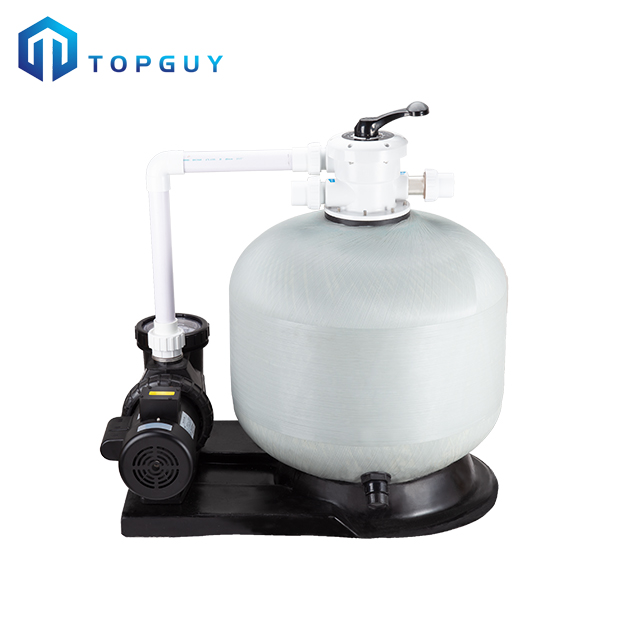

A pool filtration system has three core jobs: circulate water, trap debris, and return clean water to the pool. Every component in the chain matters.
Water is drawn from the pool by a circulation pump, pushed through a filter tank, and returned through the return jets. The filter tank — typically filled with sand, cartridge media, or diatomaceous earth — captures particles as small as 20 microns. Sand filtration is the most widely used method globally, largely because of its low maintenance demand and long service life.
The pump and filter must be properly matched. A pump that moves more water than the filter can handle will push unfiltered water back into the pool. Undersizing the pump, on the other hand, leaves water stagnant in certain zones. Proper hydraulic matching is the foundation of any effective swimming pool filter setup.
A full filtration system includes several interconnected parts. Understanding each one helps you make smarter purchasing decisions and avoid common setup mistakes.
Component | Function | Key Selection Criterion |
|---|---|---|
Circulation Pump | Moves water through the system | Flow rate (m³/h) matched to pool volume |
Filter Tank | Removes particles and debris | Tank diameter and media type |
Multiport Valve | Controls filter, backwash, rinse modes | Port size and pressure rating |
Pipework & Fittings | Connects all components | Diameter, material, seal quality |
Pressure Gauge | Monitors filter pressure | Indicates when backwash is needed |
Skimmer & Return Inlets | Water entry and exit points | Placement based on pool geometry |
Every element in this table must work in harmony. Topguy Pool manufactures and supplies most of these components directly from its factory in Jiangmen City, Guangdong, China — giving buyers access to coordinated equipment at competitive prices without sourcing from multiple suppliers.
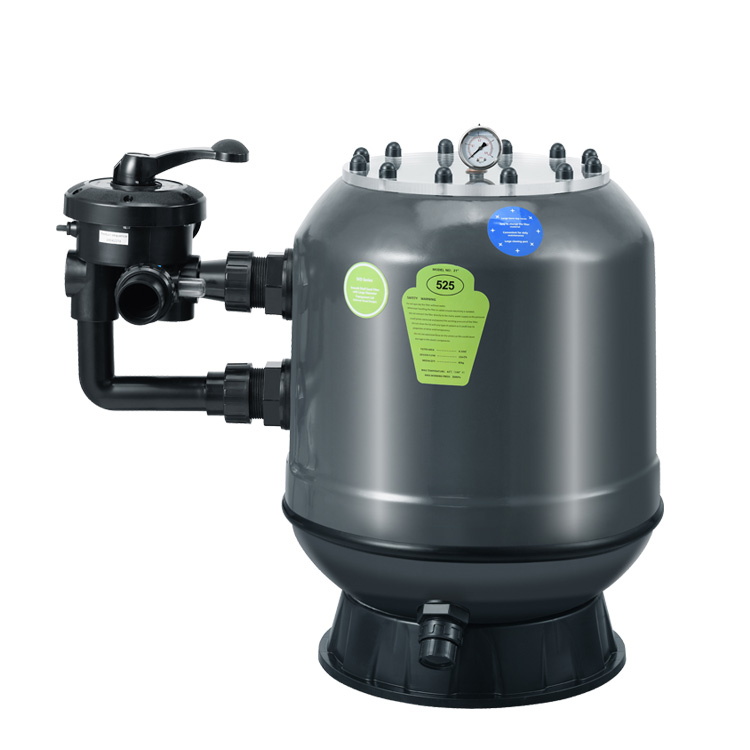
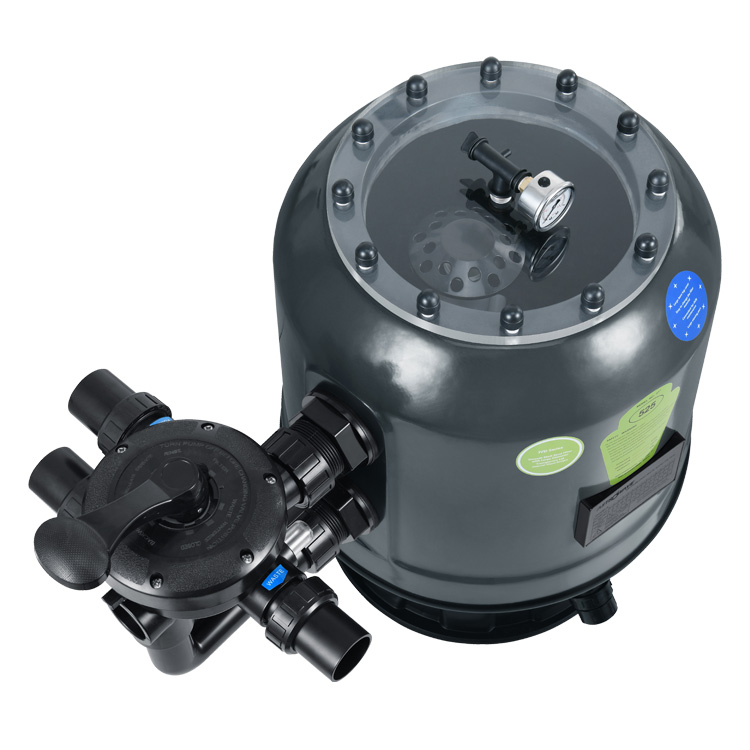
Residential pools and commercial facilities share the same filtration principles, but the scale and regulatory demands are entirely different.
A backyard pool might hold 50,000 liters. A hotel pool, public aquatic center, or resort facility can hold ten times that volume — and serve hundreds of bathers per day. Higher bather loads introduce more contaminants: sunscreen, body oils, sweat, and organic matter. The filtration system must turn over the full water volume multiple times daily to keep conditions safe.
A high-capacity commercial sand filter is the standard solution for these environments. Larger tank diameters — typically 800mm to 1200mm or more — allow for greater media depth and higher flow rates. Side-mount valve configurations are common in commercial setups because they make maintenance easier when the tank is large and heavy.
Topguy Pool's commercial filter range includes fiberglass, HDPE, and stainless steel tank options. Each is engineered for extended operational cycles, reduced backwash frequency, and compatibility with high-output circulation pumps. These products carry CCC certification in China and selected models hold CE certification for export markets.
Undersizing is one of the most common mistakes pool builders and operators make. Here's a straightforward approach to get it right.
Step 1 — Calculate pool volume. Length × Width × Average Depth gives you the volume in cubic meters. Multiply by 1,000 to convert to liters.
Step 2 — Determine turnover rate. Residential pools typically require a full water turnover every 6–8 hours. Commercial pools often target 4–6 hours, or even shorter depending on local regulations and bather load.
Step 3 — Calculate required flow rate. Divide the pool volume (in liters) by the turnover time (in hours) to get the required flow rate in liters per hour.
Step 4 — Match filter and pump. Select a filter rated for that flow rate at the correct operating pressure. Then choose a pump whose performance curve delivers the required flow at the system's head pressure.
For facilities that need a complete, pre-matched solution, Topguy Pool offers packaged filter systems that pair pumps and tanks with matched pipework and valves — simplifying the procurement and installation process considerably.
Founded with more than three decades of manufacturing experience, Jiangmen Topguy Electromechanical Equipment Co., Ltd. produces a comprehensive range of swimming pool and spa equipment from its factory in Jiangmen City, China. The product line spans water pumps, sand filters, underwater lighting, cleaning equipment, and complete filter systems.
Topguy Pool's manufacturing process — from mold design to final assembly — is handled in-house. This vertical integration gives the company direct control over quality at every production stage. All products meet CCC certification standards, and selected lines carry CE certification, making them suitable for international projects.
For buyers sourcing a commercial pool filter or a full residential filtration package, Topguy Pool offers factory-direct pricing without the markup typically added by intermediaries. The company ships globally and provides professional after-sales support through its dedicated customer service team.
Not all filter tanks suit every pool. Here's a quick breakdown of the main options Topguy Pool offers:
Fiberglass (Gelcoat) Sand Filters — Lightweight, corrosion-resistant, and suited to most residential and mid-size commercial pools. Available in top-mount and side-mount configurations.
HDPE Sand Filters — High-density polyethylene construction offers excellent chemical resistance. A practical choice for pools using aggressive sanitizers.
Stainless Steel Sand Filters — Maximum durability for high-demand commercial environments. Resistant to pressure, heat, and chemical exposure.
Deep Sand Filters — Greater media depth improves filtration efficiency and extends cycles between backwashing. Ideal for pools with higher organic loads.
Each filter type serves a distinct purpose. Choosing based solely on price often creates long-term operational problems. Matching the tank material and configuration to your specific environment — indoors or outdoors, residential or commercial, freshwater or saltwater — is the smarter approach.
A correctly planned pool filtration system pays for itself quickly. Fewer chemical corrections, longer equipment lifespan, and consistent water quality all reduce operating costs over time. The upfront investment in properly sized, well-matched equipment is almost always lower than the cost of fixing a system that was set up incorrectly.
Topguy Pool's technical team is available to help specify equipment for new builds and retrofits. Whether you're outfitting a single residential pool or sourcing for a large commercial project, the company offers the product range, manufacturing quality, and direct pricing to support your requirements.
Visit topguypool.com to explore the full sand filter and pump product range, or contact the team directly for a project-specific recommendation.
Most commercial pools require a full water turnover every 4 to 6 hours. High-traffic facilities, such as public aquatic centers or hotel pools with many daily bathers, may target even shorter turnover times to maintain safe water quality. Local health regulations often specify minimum turnover requirements.
A sand filter should be backwashed when the pressure gauge reads 7–10 psi above the clean operating pressure — typically every 1 to 2 weeks for a well-sized residential pool. Commercial pools with higher bather loads may require more frequent backwashing.
A top-mount filter has its multiport valve positioned at the top of the tank. A side-mount filter has the valve on the side. Side-mount configurations are more common in larger commercial tanks because they are easier to access and service at ground level.
A quality sand filter tank can last 10 to 20 years or more with proper maintenance. The filtration media (sand or glass) typically needs replacing every 5 to 7 years, depending on pool usage and backwash frequency.
Yes. Topguy Pool offers complete filter systems that pair circulation pumps with filter tanks, valves, and fittings. Purchasing a matched system simplifies installation and ensures all components are hydraulically compatible.
